
No products in the cart.
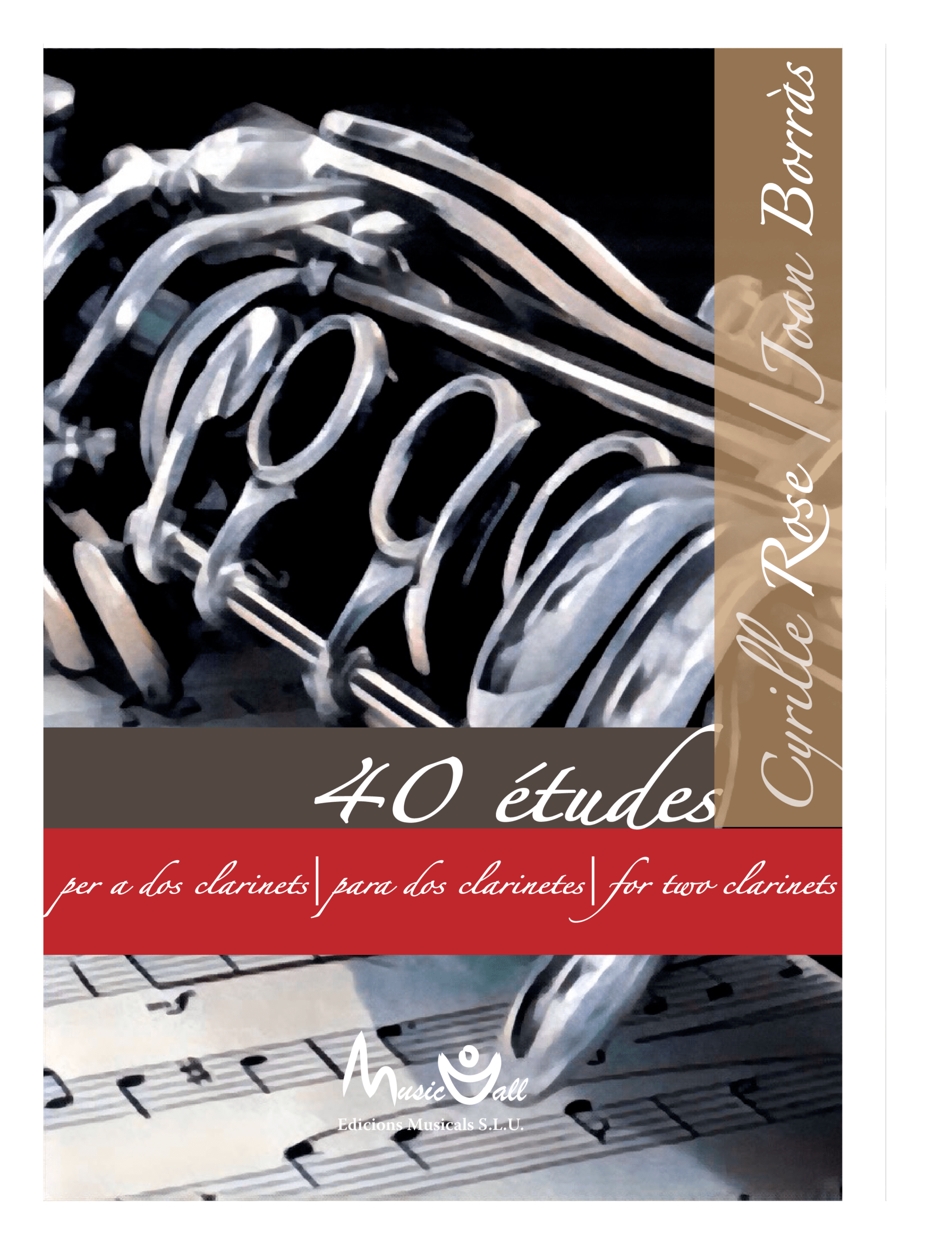
40 studies
35,00€ Taxes included
Title: 40 studies
Composer: Rose, Cyrille / Borràs Grau, Joan J.
Instrumentation: Two clarinets
Pages: 125
Level difficulty (1-5): 1
In Stock
Recent Views
Miniatures
19,00€ Taxes included
Fantasy
26,00€ Taxes included
Description
The first publication of Cyrille Rose’s 40 Études dates from 1884. It was published by the Parisian publisher Richault, which was also responsible for the first publication, among many other scores, of clarinet works such as Ferdinand Ries’s Sonata Op. 29 (1812), Grandval’s two pieces for clarinet and piano (1885), Gouvy’s Sonata Op. 67 (1880), and some of Anton Reicha’s Wind Quintets.
The 40 Études, published from the outset in two volumes (Livres), are arranged and adapted for the clarinet by Cyrille Rose, drawing on music by composers such as:
Charles Dancla (1817–1907), a violin professor at the Paris Conservatoire and therefore a colleague of Rose at the institution; Federigo Fiorillo (1755–1823), a German violinist and composer of Italian origin, from whom Rose selected several studies taken from his famous 36 Caprices for Violin, Op. 3; Rodolphe Kreutzer (1766–1831), the celebrated French violinist, composer, and conductor, a pupil of none other than Anton Stamitz. He was the dedicatee of a violin sonata by Beethoven whose far-reaching influence even inspired a novel by Leo Tolstoy; Pierre Gaviniés (1728–1800), a French violinist, pedagogue, and composer, who was both a professor and colleague of Rose at the Paris Conservatoire; Jacques Féréol Mazas (1782–1849), a French violinist and teacher, represented here through several studies drawn from his Op. 36; Franz Schubert (1797–1828), himself an accomplished violinist, who also contributes to this collection; And Ferdinand Ries (1784–1838), Beethoven’s renowned pupil, who enriches the collection with some of its most beautiful and lyrical studies.
The distribution of the studies are: Dancla (Études 1, 2, and 12), Fiorillo (3, 5, 16, 18, 24, 25, 30, and 33), Kreutzer (4, 6, 8, 9, 11, 19, 27, 31, and 37), Gaviniés (7, 15, and 17), Mazas (10, 13, 20, 21, 26, 28, 29, 35, and 36), Schubert (14, 22, 23, and 40), and finally, Ries (32, 34, 38, and 39).
The 40 Études represent the natural continuation of the 32 Études (published by the same publishing house). Rose introduced them into the pedagogical curriculum of the Paris Conservatoire, where they remain in use to this day. A pupil himself of Hyacinthe Klosé, Rose went on to teach a number of truly distinguished students, among them Prosper Mimart, Henri Paradis, the brothers Henri and Alexandre Selmer, the brothers Manuel and Francisco Gómez, Louis Cahuzac, and Henry Lefebvre, whom he regarded as his best pupil. Lefebvre was the teacher of Daniel Bonade, who is considered the founder of the American clarinet school, transmitting his legacy through clarinetists such as Anthony Gigliotti, Robert Marcellus, and many others.
Rose’s studies have formed —and continue to form— part of the technical and musical education of generations of clarinetists in both Europe and America. Bonade, like Marcellus and so many others, regarded them as a fundamental component of the standard course of study. Their pedagogical importance is crucial, which explains why they have been the subject of numerous academic and research studies.
Rose’s selection of the various études is conceived as a carefully balanced set of challenges that enables the student to deepen and refine control and mastery of the essential technical and musical skills required of every performer: tone quality (timbre, intonation, dynamics, legato), finger technique, articulation, rhythm, and phrasing. So, these studies are directed toward objectives in these broad areas. Without claiming to be exhaustive, I propose here a classification of the skills addressed by each étude, which I believe may be especially useful for young clarinetists when planning their daily practice more consciously:
Études focusing on two fundamentals
Tone and finger technique: 1, 2, 4, 7, 12, 14, 15, and 27.
Tone and articulation: 22, 25.
Études focusing on three fundamentals
Tone, articulation, and finger technique: 5, 6, 8, 10, 11, 16, 19, 23, 24, 28, 30, 31, 33, 37,
and 40.
Tone, finger technique, and phrasing: 9.
Tone, rhythm, and phrasing: 21.
Tone, finger technique, and rhythm: 38.
Études combining several fundamentals
Tone, finger technique, rhythm, articulation, and phrasing: 3, 4, 17, 18, 20, 26, 29, 32, 34, 35, and 36.
As noted in the preface to the edition of the 32 Études for Two Clarinets (Musicvall, Edicions Musicals – ISMN: 979-0-805472-18-8), this publication of the 40 Études introduces the significant novelty of including a realization for clarinet duo, in which the upper voice faithfully preserves the original études. In this way, the pedagogical possibilities and formative potential of these studies are greatly enhanced. Beyond their proven effectiveness for individual practice of the various fundamentals outlined above, the option of working on them in duo format —as chamber music within the clarinet studio— multiplies their educational benefits exponentially.
Joan Borràs
PhD in Musicology / Teacher at the RCSMM
¡Haz clic para puntuar esta entrada!
(Votos: 0 Promedio: 0)
Additional information
| Weight | 2 kg |
|---|---|
| Dimensions | 2 × 21 × 29 cm |
| Format | Complet set |
Only logged in customers who have purchased this product may leave a review.
Related products
-
ISMN: 979-0-801260-08-6
“…among the waters”
21,00€ Taxes included -
ISMN: 979-0-801260-12-3
Little Suite – Concert
Price range: 30,00€ through 90,00€ Taxes included -
ISMN: 979-0-801260-02-4
Wedding March from Lohengrin Opera
13,00€ Taxes included -
ISMN: 979-0-801260-10-9

Five brass instruments
26,00€ Taxes included
Reviews
There are no reviews yet.